Thursday, 24 March 2011

Post 33: Alpha Charlie crosses the Equator Northbound


Coming in to land at Principe, just north of the equator

March 24
Port Gentil, Gabon, to Principe, Republic of Sao Tome and Principe
165 nautical miles
Flying time: 1hr 36 minutes

The Equator..well..just
Crossing the line: Alpha Charlie crosses the Equator, heading north, at precisely 15hrs 27mins 26 secs UTC. No weird or humiliating ceremonies for the crew in accordance with ancient naval tradition . I try and take a picture of the GPS at 00 degrees 00 minutes 00 seconds. The aircraf is faster than the camera. ( Left) I give Alpha Charlie a pat. We have come a long way together.  
Fuel finally arrived at Port Gentil at lunchtime. Not a good time to fly in the tropics but the forecast was OK.  We pay our bills at Le Meridien hotel,  rush off to the airport, fill up with the precious liquid, don our life jackets, agree quickly who would do what if we ditch in the Gulf of Guinea  and take off on the 160 nautical mile sea-crossing to Principe. Fortunately the former Portuguese colony of is an hour behind Gabon. We gain an hour's flying time before sunset.
This is the scary Intertropical Convergence Zone, or ITCZ. My mate Laurie Kay ( ex chief flying instructor on 747s for South African Airways ) had given Jo and I a masterclass on the ITCZ before we left Johannesburg. “ Just stay clear of CBs, the big scary cloud which rise tens of  thousands of feet, boiling and churning, at their heart killer downdrafts which can fling you to earth in a moment. If the forecast (assuming you can get one) says there’s a line of them don’t take off. If your path is blocked ahead turn back or divert. “

The ITCZ is the region that circles the Earth, near the equator, where the trade winds of the Northern and Southern Hemispheres come together. On a satellite image the ITCZ   shows up as a deceptively benign thin belt of cloud encircling  middle earth. It works like any thunderstorm. But big time. The intense sun and warm water of the equator heats the air. As the air rises it boils and churns and expands and then cools, releasing moisture in an almost perpetual series of thunderstorms. Some grow into hurricanes. The location of the ITCZ varies over the year. Over land, it moves back and forth across the equator following the sun's zenith.. Over the oceans the seasonal cycle is more subtle.
Runway 18, Principe
Our little Strikefinder weather radar lights up like a Christmas tree when we take off from Port Gentil. But it’s all to the west and some to the east. We cleave a path through it at FL65 or 6,500ft.
We are cleared to land at Principe by Sao Tome approach. The ATC asks every passing aircraft for a phone number. It's a search and rescue thing apparently If you don't arrive according to your flight plan, they ring your mobile.

The controller asks an American pilot in a passing Pilatus PC12 " Do you have a  contact number? " No Sir". Pregnant pause. Click, whirr. " OK.Do you have a PO Box, a Post Box?" The American replies, somewhat humourlessly I thought, " We don't have PO boxes in the States" 


Daybreak at the Bom Bom hotel Principe
Principe's haunting peaks are starkly contrasted against a darkening sky, backlit by the setting sun. We land on runway 18 which rises and dips to be welcomed by schoolchildren at the end of their day. It’s a lovely, unspoilt tropical island.

Kids at Principe
 March 25: Our next stop is Nigeria. We’re hoping to go to Port  Harcourt, refuel and head north Kano to spend the night. The weather looks dodgy. The ITCZ has come to life. Conditions are IFR in Port Harcourt. And it's pouring in Principe. We might be stuck in Paradise for a day or two.


Wednesday, 23 March 2011

Post 32: Waiting for Avgas. Waiting for the bus. Waiting for Africa.

March 23
Port Gentil, Gabon


.
A congo serpent-eating eagle waiting. But not for
Avgas.

Third day without Avgas: The fuel we need to move on is still “ en route” from Cameroon or Libreville. Who knows. Reminds me of a story by the Polish foreign correspondent Riszard Kapucsinski who writes elegantly about Africa if not always reliably. But he does get the gist. In his anecdotal book Shadow of the Sun he tells how he boards a bus ( in Ghana if memory serves me). The bus is scheduled to leave at 3:00 pm. “ Will it be on time?” he asks the driver. “ Of course”.  At 4:30 the bus is still there. It finally leaves two hours late, nearly full.“I thought were leaving on time. What do you call this?” asks the Pole “ On time Sir” replies the driver “ On time means when the bus is full”. Makes sense. Have another beer.
UPDATE March 24: the Avgas has arrived in Libreville. But the man who will bring it here by boat has no..fuel. He also has no money.
More money changes hands. Who knows? Have yet another beer.
Fishwife with the catch of the day

 Gabon is a small, rich beautiful country. An ex-French colony. 1.5 million people. Relatively stable. Relatively corrupt. But some people are trying. Oil, timber, natural gas, gold, manganese, uranium, hydropower and fish.

Togolose fishermen on contract to the village
The Gabonese themselves don’t do fishing. Any more than oil-rich Gulf Arabs do manual labour. They employ Togolese ( another small country to the north: their team got shot up in Cabinda before last year's World Cup) The Togolese fishermen come here for 2-5 year stints. They fish in long pirogues with hand-made sky-blue nets close to shore. It’s good money. They seem content.


Jo and the Big Fish: 
The village boss is a large, jolly man who has an I-phone and makes a coconut-based spirit with a lethal root marinating in the bottle to give it extra kick. Would you like some he asks? " C'est pour les hommes. Si vous me comprenez?" Je vous comprends monsieur. Mais je suis trop vieux."  I pass. He laughs.
A guy we meet who works for the newly-elected President says he doesn’t understand why people complain against Gadaffi. The Gabonese governement, along with (some) other African nations has neverthless backed the attacks by the US, Britain and France on Libya. US power still holds sway. And autocrats, even benevolent, elected ones, are nervous of this unpredictable wind of change. So they hedge their bets. Our friend, whom we meet by chance, is a recent convert to Islam. But secular. Reasonable. One third of Gabon’s population is now muslim. The proportion relative to other religions is growing. I don’t pretend to understand Africa.

A beautiful, curious lizard. Answers on a postcard please
Pygmies are said to be Gabon's oiriginal inhabitants. Gabon has over 40 distinct ethnic groups.There are believed to be no more than 3000 pygmies left, scattered through its beautiful equatorial forests. The rainforests are full of rare and beautiful birds sch as the Congo Serpent eagle and the Booby.  

MY TWITCHER ( SORRY: ORNITHOLIGIST) COUSIN: I Google Gabon/trees. I find the following quote from my cousin Rhett Butler, a distinguished naturalist and a man who will go to any lengths to seek rare birds. He lives a short trip by dugout canoe ride from Gabon, on the other side of Africa, in Zimbabwe. Makes my day.

"This heavily forested nation has a tremendous amount of biological diversity and serves as an important sanctuary for many animal species. Gabon has numerous endemic species and vast tracts of pristine rainforest which make up almost 40% of the country's rainforests."
- Rhett A. Butler


Tuesday, 22 March 2011

Post 31: Good news. The Mooney is fixed. But an Antonov crashes trying to land a Pointe Noire shortly after Fox Formation takes off

March 21
Port Gentil, Gabon
307nm
2hours 40minutes flying time


One of the two Antonovs taking off from Pointe Noire
An hour later one of them crashes into a residential district
 coming into land
 An Antonov 12 crashes coming in to land at Pointe Noire just after we take off
Good news and appalling flying news today. A Russian-made, Russian-crewed Antonov 12 cargo plane crashes coming in to land at Pointe, Noire, Congo Brazzaville. It ploughs into the residential district of Mvou Mvou about 45 minutes after we take off on Runway 18 for a right turn heading north for Gabon. Pointe Noire is the country’s economc capital and a big port. The airspace is busy. And it’s hot. The latest death toll is 23, including crew.
As we wait to refuel we see two Antonov’s take off, dark smoke trailing their powerful turbine engines. (See picture) Bernard says they seem heavy and appear to take an awfully long time to get off the ground.   

The Mooney on 6-ton Jacks waitingto tests its undercarriage
 The Mooney is fixed: The good news is the hand-crafted, 3-inch metal rod for the Mooney’s broken undercarriage works. Eventually. Bernard carries out a test flight first thing. He takes off, retracts the wheels and does a low pass in front of the tower. They tell him the wheels seem to be up and the doors are closed. He banks and brings the Mooney into land. As he does, the new rod holding open one of the two doors which close in sequence, after the wheels are up, snaps again. He decides to fit the original rod which he’d had welded at a roadside “ garage” the night before by a  smiling Congolese with two enormous Acetylene welders.

Bernard fiddles and fixes
 Bernard borrows two 6-ton jacks, courtesy of Heli Union, a local helicopter outfit. Flying Farmer Martin and Helmut put the jacks in place. They lift the Mooney ( MTOW 3668 lbs) off the ground. If the doors close he’ll give it a go. If they don’t it’s game over. The problem is that the Mooney (usual cruising speed 175 knots) can only do 109kts with its undercarriage down. There just wouldn't be enough refuellng points to get him out of Africa.


The Mooney flying wheels down at 107 knots, two thirds
of its usual crussing speed, along the Congolese coast
 ( Picture: courtesy Martin from G-OSL)

Tense. He retracts and lowers the undercarriage on the ground three times. It works. Great relief all round. And great tam work. A real sense ofquiet and well-deserved accomplishment by the small group who worked on the problem


Flying farmer Martin jacks up the Mooney

The formation takes off in sequence for Port Gentil, just over 5o miles south of the Equator. It’s 40 degrees centigrade ( 100F) on the apron at 10:00 am.


On the way north Jo skims the coast at 200 feet over the beaches. We see a small herd of elephants, including a calf.  It seems like a good omen. We get to Port Gentil to be told that our Avgas, which is being trucked to Libreville from Cameroon, to the north, is stuck at the border. We will have to spend an extra night in Port Gentil. Helmut in the big Cessna with Kiwi Adam and Antoinette, the Flying farmer's better half - plus Al and Charly in the Bumblebee - have gone ahead to the paradisical island of Principe. The group is divided again. Not ideal. I’ve learned to take things day by day.

Sunday, 20 March 2011

Post 30: The Mooney has a problem as we fly into the Heart of Darkness

Skimming the beach off Angola at 200ft. Memories of
 Darius and Heinro in Mozambique
March 20
Dateline: Hotel Elais, Boulevard Generale de Gaulle, Pointe Noire, Congo, Brazaville
Todays leg: Sumbe, Angola via Cabinda to Pointe Noire in Congo Brazaville
2 hops
395 nautical miles
3 hours 49 minutes flying time
Health warning: You will need a map to make sense of this post


A cannibalised Antonov at The Aero Club
Pointe Noire, Congo Brazaville and club aircaft
 The Mooney has undercarriage problems: Bernard’s powerful Mooney has damaged its rectractable undercarriage. Bernard notices it this morning at Sumbe, where we landed two days ago, in a gusting crosswind with vicious windsheer. All of us struggled to get our aircraft safely on the ground. Jo did well with Alpha Charlie.The Mooney has a complex system. Two doors have to close in sequence when the wheels are folded up into the wing. One door did not. The problem may have nothing to do with the tricky landing. In any case on takeoff today for the Congo, the Mooney’s wheels would not retract. Bernard tries side-slipping the aircraft to nudge the door closed. No joy. He and his co-pilot, Derek, decide to push on and try and fix it tonight.

Fortunately we are guests of the ( French) Aero Club at Pointe Noire. It’s full of pilots and “ bricoleure”, handymen.  
Bernard handcrafts a part
 for his stricken Mooney
Bernard and Uberpilot Helmut ( stripped to the waist) spend 3 hours in sauna-like heat hand-crafting a part.They will go for a test flight first thing to see if it works.


Angola: women really don't hasve it east here


Angola: Big country; major oil producer; struggling to come to terms with 40 years of virtually uninterrupted war; an estimated 10m landmines were sown; 2 million people died; endemic corruption all the way to the top,not helped by western oil companies with huge slush funds; stunningly beautiful; over 1600km of breathtaking Atlantic coastline; fabulous gameparks sadly depleted by war and poaching; a trickle of tourists since the civil war ended in 2002

Here is an email about Angola I got yesterday from Quentin Peel, my old mucker and ex-Africa Editor of the Financial Times
“Angola I fear now very corrupt. Oil money has worked its evil. Cubans went home. Chinese arrived, but live in enclaves in neo-colonial style. I only visited once. Went south with army convoy at the time to see if the South Africans were making mischief, and got shot up by South African air force. ( Before the end of Apartheid South Africa invaded southern Angola. They saw it as their backyard) A (Communist) East German correspondent kept asking smugly: “Why are your friends shooting at you? Mike Woolridge (BBC) got hit by shrapnel in SA bombing raid. On an earlier trip, I drove from Windhoek( capital of Namibia) to the border with Angola when western contact group were trying to negotiate a ceasefire. I met a black petrol station owner who spoke German (I was driving with a foreign correspondent from Der Spiegel, the German magazine). I asked him what he thought of western peacemaking. "The trouble with the western powers was they made the wrong decision in 1941," he said. "Sorry?"  He said : "They didn't back Adolf Hitler when he invaded the Soviet Union." Africa is weird and wonderful." Thanks Q. Here' s to the FT's corps of foreign correspondents.
Overflying Luanda, Angola' capital
Cabinda and the mouth of the Congo river
This bit is complicated. Bear with me. It’s worth it. We fly from Sumbe to the Angolan oil enclave of Cabinda.This is sandwiched between two, separate nations. BOTH are called Congo.
In the south is what is euphimistically known as the Democratic Republic of the Congo ( formerly Zaire). This was explored, subdued and handed to Belgium by our very own Henry Morton Stanley of “ Dr Livingstone, I presume” fame in the 19th century.

It is also the setting of Joseph Conrad’s poetic novel “ Heart of Darkness”,a study of corruption which flows from unlimited power. Plus ca change. Plus c'est la meme chose.
On the northern banks of the mighty Congo river ( the deepest and possibly the most powerful in the world) is Congo Brazaville ( a fomer French territory). I hope you’re still with me.
Cabinda sandwich
Last year, just before the soccer World Cup, the national team of Togo was shot up by separatist rebels after it crossed the border into Cabinda. They came in by road. I don’t know why. Two players and the coach died.Others were injured including Emannuel Adebayor, formerly Arsenal and Manchester City now with Real Madrid.
We are told we have to get clearance from Kitona military airbase in the Congo or skirt their airspace 15nm out to sea if we don't want to be invited to land by their fighers jets. It’s Sunday. Nobody’s in the tower, much as in the UK. No worries. Jo and I decide to go down to 200ft to check out the coastline. I am reminded of Darius Briers who extracted me from Mozabique with Heinro three weeks ago.We did the same on the east coast of Africa. We overfly the runway at Luanda, the Angolan capial, at 2500ft. The visibility is gin-clear. Abeam, dozens of tankers are waiting to load their precious cargo of oil. The sea just off the coast is dotted with oil platforms. Enormous flames burn off excess gas from the drilling rigs.

The Congo river from 2500ft

Before we get to Cabinda we reach the mouth of the Congo river. It is, excuse the cliche, an awesome sight. I have to say to myself several times” You are flying abeam the Congo river”

Friday, 18 March 2011

Post 29: Fernandez our forward spotter into Angola; some thoughts on autopilots and other gizmos

March 17, 2011
Mokuti, Namibia, to Lubango in Angola via Ondangwa
Two hops
325 nautical miles
3hrs 40 minutes flying time


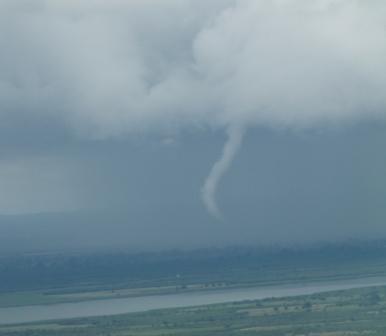
A twisting spout of moist air and heavy rain over the great plains
 onthe way to Angola
 We meet Fernandez, by chance, at Ondangwa, the last stop in Namibia before we enter Angolan airspace. We have stopped to refuel and complete exit formalities out of the country.  Paperwork. Fernandez flies a twin-engined Cessna 206, ferrying VIPs and cargo around Namibia and Angola and further north. He comes over as reassuringly competent and trustworthy. He offers to act as a forward spotter for us into the high ground over the Angolan border and onto to Lubango using his state-of-the-art weather radar. TAFs and METARs ( local weather forecasts tailored to the needs of pilots) are, to say the least, a luxury in most of Africa.

March 18
Lubango to Sumbe on the Angolan coast
Just over 200nm
Around 2hrs 20minutes flying time

A low hours pilot (and two veterans) muse about autopilots and suchlike in little planes

A Curtis B-2 flies, pilotless, over Sacramento,Ca
in 1930 controlled by Sperry gyroscopes

Autopilots are for big planes. And for small ones ..with lazy pilots. I exaggerate to make a point. But that’s the essence of the debate in the General Aviation community about these wondrous bits of kit. The same goes for GPS systems. The GA community is broadly divided between two extremes and a middle: those who think GPS systems, autopilots, Mode S transponders and - heaven help us- Traffic Avoidance Systems- are a waste of time and money. They can be a positive menace because they seduce you into fiddling with them, distracting you from keeping a good lookout and flying the plane. The other extreme can’t get enough of them. The middle ground understands the principles of sound airmanship but thinks, hey, this is the 21st century, the skies are getting busier, a pilot’s workload is high enough. So don’t look a gift horse in the mouth. No prizes for guessing which group I belong to.
An autopilot revolves around a gyroscope. In simple terms, it keep your aircraft doing what you want it to do by controlling its flight surfaces: ailerons, rudder, elevator and tirm, to maintain its axes. They were invented by Lawrence Sperry, an American. In 1914 Sperry flew his Curtis C-2 over the villages of Bezons and Argenteuil, near Paris in an aircraft safety competion. As he approached the crowd, the band struck up 'The Star Spangled Banner.' He passed the judges stand with both his arms held high. On his final pass his French engineer climbed onto one wing and Sperry on the other. The pilot's seat was empty. The aircraft flew serenely, straight an level, “hands off”. The judges were speechelss. The crowd went wild. " Formidable!"
So far Alpha Charlie has carried us nearly 12,000 nautical miles from England. The average leg has been in the low 300nms, maybe 320 nautical miles. That’s around three hours flying, depending on whether the wind is on the nose or on the tail. On some days we’ve flown for over 7 hours.
Alpha Chalie has a 2-axis S-Tec autopilot. It’s an ultra-reliable piece of kit. It will capture and hold a heading, an altitude, climb and descend on command and follow a flight plan entered into the stalwart Garmin 430 GPS system. I reckon the autopilot has done 85 per cent of the flying so far. Pretty much faultlessly. It will fly through turbulence. If things get too bumpy it’s wise to disengage and fly by hand. But on long legs – and on busy approaches when you have a lot to do (frequencies, joining the circuit, looking out)- they make flying easier and more enjoyable. They allow you take pictures without worrying about who’s in control. And, erm, manage other essential inflight needs.

No hands: Alpha Charlie at 8,500 feet amsl heading for the coast
at Sumbe, Angola on autopilot

Over supper in Lubango, our first stop in Angola, Bernard, who owns the hand-built Mooney (a sort of TVR of the sky), respected aviation journalist and hugely experienced pilot said: “ It’s simple. My AP reduces my workload. “ He made some interesting points about autopilots in big planes.
“ Nearly all airliners are flown on AP most of the time. Take-off is manual but at 300 feet the pilot presses a button. Most modern airliners can also land (and often do) in pretty much nil visibility on AP. You just punch in the destination airport ICAO code into the flight management system. When it gets there the autopilot captures the glideslope on the Instrument Lsnding System (ILS) and lands the plane. It almost always does a better job than its human counterpart. In some aircraft it’s mandatory for the AP to land the plane every so often. But the public isn’t ready for the idea that their flight in a 747 or an Airbus, and their safety, is in the hands of a robot. So airlines don't bang on about them."

My mate Laurie Kay, who used to be chief flying instructor on 747s for South African Airways, texts the following: " Many of my students on the 747 used to ask why I put the autopilot on at 400 feet after take-off. I told them because the AP wasn't certified to be engaged any earlier! If you've got - use it." Yes captain.

Under strict instructions from home, on pain of
excommunication, here  is a picture of Alpha Charlie
at Sumba, Angola. I blame Jo, my co-pilot who sent it to
Victoria in the first place.


Wednesday, 16 March 2011

Post 28: The Etosha Pan, weaving in and out trouble; Alpha Charlie gets a mud bath

March 16
Swakopmund to Mokuti
269 nautical miles
2hrs 50mins flying time

From desert to savannah and high ground


Fox formation is, for the first time, back together for the northbound leg. Minus David and Angela in the Cessna twin, sadly missed, who are back in th UK after their nosewheel collapse in the Sudan and William in the Whisk. We leave the coast and head inland. The landscape changes from desert to savannah.We head in loose formation towards the Etosha Pan, a 75-mile long dry lake, at the heart of one of the great game reserves of Africa.


A "benign" CB. Just don't it for granted
 We climb initially to 1,500 feet on the QNH ( a sorr of average above mean sea level) and are then are cleared to fly " low level" at FL55 ( 5,500 feet) by Walvis Bay. The terrain rises gently but unmistakeably. So does the temperature. So do the clouds. As we approach Etosha it becomes murkier. In the distance we see a Cumilonimbus (CB) cloud forming in a great tower. These can sometimes rise to 60,000 feet. This one is relatively benign. It shows no electrical activity on Alpha Charlie's Strikefinder storm detection gizmo. We nevertheless respectfully give it a wide birth. My good friend Laurie Kay gave Jo and I a masterclass in navigating tropical storms before we left Johannseburg.


Fine cloud chimneys

 Closer to Mokuti the Etosha Pan stretches to the left. The visibility clears but chimneys or curtains of fine, low cloud stretch from the solid base above to the gound below at 10-20 mile intervals. We weave in and out of them and occasionally through them to give Alpha Charlie a shower. Derek, in the Mooney, and I later debate what to call them. Answers on a postcard please. We land on the mostly dirt strip of runway 26, a bit short. Alpha Charlie gets a (mud) bath. She goes to bed in a bit of a huff. Her last words: " I am an aeroplane. Not a hippo."

The Etosha pan..filling after heavy rainfall from Angola

An Etosha elephant: a terrestrial CB

Tomorrow we go Angola, a beautiful country ravaged by civil war where over 10m landmines were planted with a budding ecotourism industry.

Tuesday, 15 March 2011

Post 27: Sand, dunes, a diamond rush,a ghost town and a mercy flight


Captain R Jones, the skipper who started the diamond rush in
South West Africa
Monday March 14
This may sound odd but I don’t much like travelling by air. I love flying. But going by plane means you can’t really take in the difference between one place and another. My advice is: get there, hire a car or take a bus. Talk to people. It never disappoints because you never know what to expect. After nearly 11000 nautical miles- even at Alpha Charlie’s sedate pace- places are beginning to blur in my mind: Libya, Khartoum, Quelimane, Kenya, South Africa.
But every so often you come to a place, unannounced and unscheduled that really sticks in the mind.  Luderitz, the diamond mining ghost town in southern Namibia, is such a place. If I were Pedro Almodovar this is where I’d set my next movie.
Bartolemeu Diaz, the Prtuguese seaferer, passed through this barren place in 1488. But the real story begins in 1897 when  passing skipper, Captain R Jones, arrived in Capetown, to the south, clutching a parcel of diamonds which he said he found in South West Africa, then a German Colonial Territory. His find had sparked a diamond rush. A railway was built. The magnificent town of Luderitz rose up out of the desert, whence some has now returned. Ernest Oppenheimer established the Consolidated Diamond Company of South West Africa, today De Beers. Fortunes were made. Fortunes were lost. Competition was brutal. Employment ( mainly of blacks) bordered on slavery. Mining companies were masters of the universe.
LUDERITZ AIRFIELD
We fly from Uppington, in South Africa, to clear customs at Keetmanshoop, just inside Namibia. I love Namibia: deep canyons, mountainous red sand dunes, savannah; the San bushmen of the Kalahari desert who are perhaps the oldest surviving (just) culture in the world; huge cattle farms battling it out with private game reserves for breathing space and scarce resources; the wonderful Etosha game park and the Skeleton Coast ( so called because of the bleached remains of stranded whales and skipwrecked vessels). Big country with a tiny population.
Alpha Charlie rides the up and don drafts on autopilot to Luderitiz over the mountains like small boat on a gentle rolling sea. At Luderitz Jo brings her in to land on runway 22 with a 22kt wind gusting 28kts from 170 degrees in a mini sandstorm. Not easy but safe. Alpha Charlie’s recommended crosswind limit is 17 knots. We are followed in by a Cessna twin, a mercy flight from Capetown to Windhoek which has come to pick up someone waiting in ambulance, light flashing, with an anxious relative.
THE OBELIX GUEST HOUSE
The owner, a charming lady who, it turns out is “mute” ( she cannot hear and is very difficult to understand) sits in the courtyard. I ask her for an adaptor plug. She asks her son, an angelic 8 maybe 9 year-old with a shock of blonde hair doing wheelies on his mountain bike, to “translate”. I tell him I’ve flown from England and can I have a plug please? Non sequitir. He pauses briefly,nods, gets the plug, then gets back on his bike. He is suitably unimpressed.  
PATRICK THE DIVER  
In town, studded with magnificent colonial German and Dutch architecture but deserted and soulless, we meet Jonathan,a diver. He works the small mining vessels which go to sea, south of Luderitz, for 21 days at a time. They are virtually all subcontracted to Namdeb Diamond Corporation half-owned by (yep) De Beers. They prospect mainly to the south. He dives to 30 metres in a dry suit ( the Atlantic waters at that depth are near freezing) and, using a sort of hoover connected to the boat above, sucks up diamond-rich gravel. On deck it is sifted in jigs, under armed guard. Its very big business. In 2009 nearly half of the 1.36 million carats farmed by Namdeb came from undersea mining off Namibia. I tell him I admire his pluck.
Tuesday  March 15
Bringing water the now deserrted mining town of Kolmanskuppe
in the diamond rush
Before taking off for Swakopmund we visit the ghost town of Kolmanskuppe. The deserted hospital, built in the very early 1900s had the first X-ray machine in Africa, a school, a dance hall and a casino. It was finally abandoned in 1956.  The visitors centre today does a nice cream tea.

The Good Times in Luderitz

Kolmanskuppe: A ghost town but with style


The indispensable Jo, henceforth Monsieur Passepartout,
parking Alpha Charlie at FYSM (Swakopmund)
( Ref M. Passepartout see Jules Vernes: Around the world in 80 days).

SWAKOPMUND
The man runway is unserviceable. I bring her in to land, after a go-around, on a vaguely recognisable, gravel runway. Just before I turn base a skydiver appears out of nowhere and lends with impeccable, Tutonic precision on the apron. This place feels like South Africa. Most of the clients at the ( very nice) Hansa hotel are Afrikaans or German wanting a slice of colonial nostalgia.
Tomorrow a game park. Then Angola and towards the Equator and the InterTropical Convergence zone.